In the cavernous networking halls of the Hamburg Sustainability Conference 2026, the air hums with the language of finance, innovation, and net-zero targets. Delegates shuffle between panels on carbon credits and regenerative agriculture, clutching espresso cups and jargon-filled briefs.
But in the corner, amid the chatter, a different conversation is unfolding. This one challenges the very premise of how the global sustainability movement operates.
Eric Agyare, Research and Partnership Lead at The Revival Earth, has just returned from a workshop where he contributed to a proposed Extended Producer Responsibility (EPR) scheme.
The scheme, designed by European entities to tax textile producers and fund waste management, is exactly the kind of “big English” policy solution that usually gets drafted in boardrooms thousands of miles away from the people it affects.
And Agyare is here to make one thing clear: that era is over.
“If we sit for the global north to put together a scheme, a solution, and they want to apply it to us, it becomes a lot more difficult,” he told culture journalist and climate activist Kenneth Awotwe Darko on the sidelines of the conference.
“We are here to be able to add our voice to it so that we wouldn’t be an afterthought.”
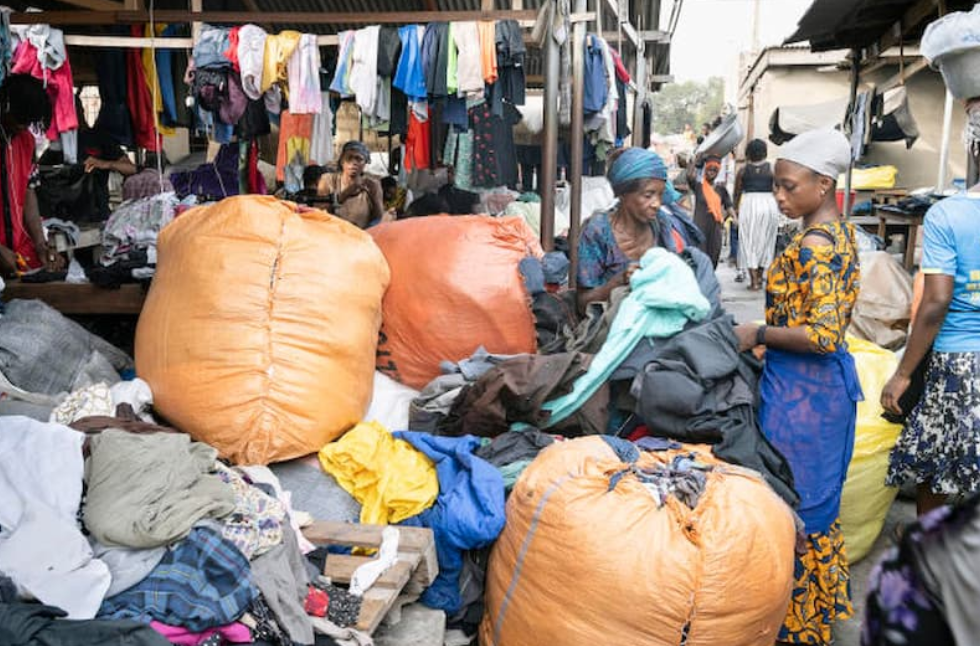
At the heart of Agyare’s message is Kantamanto, the sprawling second-hand clothing market in Accra, Ghana. It is one of the world’s largest repositories for the Global North’s discarded fashion, a receiving end of a broken system where the average European or American consumer sends their unwanted garments to “recycling.”
But in Kantamanto, recycling isn’t a buzzword. It is survival.
Over 30,000 traders and workers have, for decades, kept millions of tons of textiles in circularity. They sort, repair, upcycle, and resell what the West no longer wants. When garments are unsellable, they are converted into industrial rags, stuffing, or other valuable goods. It is an informal economy, but a remarkably efficient one. It’s a living, breathing example of the circular economy that Western nations are now scrambling to legislate.
“There’s over 30,000 workers that have been keeping these clothes in circularity,” Mr Agyare emphasised.
“They’ve got a lot of challenges, so it would be good for them to involve us a lot more so that we know that it’s a collective approach.”
Yet, the workers of Kantamanto are struggling. Mr Agyare described a deeply inequitable value chain where traders buy bails of clothing without knowing what is inside. When they open them to find trash, water-damaged goods, or utterly unsellable items, they run at a loss.
“Is Kantamanto the best working environment? No, we don’t think so,” he said bluntly. “Some people get more than the others. When a trader opens a bail and there are a lot of trash in it, the person is running at a loss completely.”
This is the reality that EPR schemes, if designed without local input, risk exacerbating. If European producers pay fees to a distant fund without empowering the workers on the ground, Agyare argues, the system becomes a public relations exercise rather than a solution.
Eric Agyare, who doubles as the Founder and Creative Director of Artlife Matters, insisted on what the Global North can learn from the Global South.
He reframes sustainability not as a modern, Western invention, but as an indigenous cultural practice. He recalls the Ghanaian tradition of passing down a grandparent’s Kente cloth through generations; a practice rooted in reverence, sufficiency, and the refusal to waste.
“If your grandma has a very beautiful Kente, when she’s tired of wearing it, it’s not going to be thrown away,” he said.
“She’s going to pass it on to an auntie… and it goes on and on. That is sustainability.”
This, Agyare argues, is the knowledge deficit in the global sustainability discourse. For him, while conferences like this one have made strides in inclusion, the dynamic in many others often remains one-directional, the West prescribing solutions, and the Global South implementing them.
He rejects that premise entirely.
“Mainly we think like, we are coming here, and they will tell us… they speak all the big English, and all that, but they need to know the indigenous, you know, African way of doing things,” he said.
“They need to also learn from us, learn techniques, learn habits, culture, ways that we are also winning. We all optimize and make sure it’s a safe world to live in.”
This “reverse mentorship” is a direct challenge to the power dynamics of the sustainability sector. It suggests that the Global South is not merely a recipient of climate aid or a dumping ground for waste, but a repository of lived solutions that are both time-tested and deeply integrated into community life.
Kenneth Awotwe Darko, the journalist conducting the interview, noted the irony of the conference environment. While the event buzzes with cross-sectoral collaboration, the economic empowerment of the Kantamanto workers remains fragile.
Mr Agyare conceded that the economic impact is “a very delicate situation.” While the market provides work, it does not always provide fairness. The mission of The Revival Earth, he explained, is to bridge the gap between the “global agenda” and the “local understanding” of traders and market women.
“We are community led,” he said.
“How can we bridge the gap between the conversations happening globally and their local understanding so that you get to know that what I’m doing is part of a bigger agenda? And how can I do it well, how can I maximize it well, and how can you also make a good life out of it?”
It is a vision that moves beyond simple charity or “awareness.” It asks a harder question: How do we ensure the people already doing the work are not just surviving, but thriving?
The conversation also touched on the broader creative economy in Ghana and across Africa. Darko observed that in many domestic conversations, the creative sector is still treated as “glitz and glamour” rather than a serious contributor to GDP or governance.
Eric Agyare agreed, urging a more deliberate approach.
“Creativity is not enough,” he said. “You need to know that it’s a business, a job, and we need to contribute to policies. We need to contribute to even forming associations, regulations and how we’ll be able to grow.”
The same could be said of the circular textile sector. It is not a side-show to the “real” economy. It is a frontline defense against environmental degradation, and it needs a seat at the table.
To be fair, some entities in the Global North are beginning to recognize the value of including “receiving end” voices in their workshops.
But Agyare believes that this is only a beginning.
“We are here to make sure the voice will be heard, to know what we are already doing, to know how they will be able to help us to scale up, and more importantly, how they can also learn from us.”
As the networking hall buzzes with the energy of thousands of delegates finding their voice, Agyare’s message is a reminder that sustainability is not a monologue. It is a dialogue, one that must, for the first time, be truly global.
“Because if we sit for the global north to put together a scheme and they want to apply it to us, it becomes a lot more difficult,” he reiterated. “So this is part of why we are here… to say, why are you taking certain incentives from producing companies? If you’re doing that, you need to also consult us locally.”
Though the conference has ended, the question lingers: Will the international community listen? Or will it continue to craft solutions in isolation, missing the very wisdom it claims to seek?
For now, the voice of Kantamanto is in the room. And it will not be silent.
That seat at the table is about to become a reality closer to home. On October 22, 2026, Mr Agyare will bring his message to the Climate x Culture Summit at the Google AI Centre in Accra.
The summit, organised by Culture Joint Media is poised to explore the critical nexus between sustainability and the arts, moving beyond the glitz of creative expression to ask harder questions about policy, economics, and community-led solutions.